Many pet-owning families face this problem:
The water bowl is changed every day, but the cats and dogs only drink a couple of mouthfuls.
It’s only when they develop urinary problems, constipation, or bad breath that they realize – it’s not that there isn’t enough water, but that the water is “not right”.
As a seasoned pet nutritionist, I would like to state a professional conclusion:
Whether a pet is willing to drink water depends on the safety of the water quality, the method of water supply, and the triggering mechanism of its behavior.
I. Product One Introduction: Basic Safety, Determines Whether to Drink or Not
LJ-304-020L-444 Stainless Steel Intelligent Pet Water Dispenser
| Product | Specifications |
| Capacity | 2L (Large Capacity) |
| Material | 304 Stainless Steel |
| Dimensions | 18.5 × 18.5 × 13.5 cm |
| Weight | 0.65 kg |
| Applicable Objects | Cats / Small to Medium-sized Dogs / Multi-pet Families |
Why must it be 304 stainless steel?
- Highly natural antibacterial properties, prone to less bacterial growth
- Smooth and dense surface, less likely to form biofilms
- Less odor residue compared to plastic
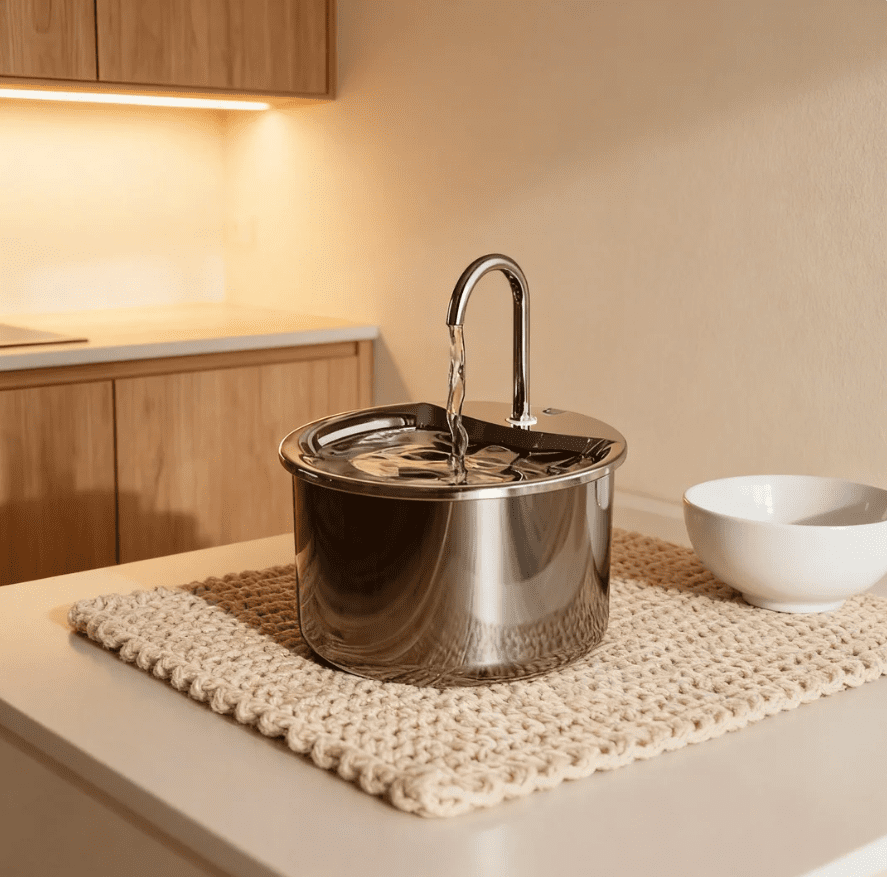
II. Product Feature 2: Continuous Fresh Water, Making Pets “Willing to Approach”
24-hour continuous water circulation system (the main reason for encouraging pets to drink)
| Comparison items | Ordinary water bowl | Continuous fresh water mode |
| Water flow state | Stagnant | Gentle and flowing |
| Odor | Easily spoiled | Continuously fresh |
| Pet interest | Low | Significantly enhanced |
Professional explanation:
Cats and most dogs are naturally more secure around “moving water sources”.
LJ-304 adopts the circulating fresh water mode (24 hours), simulating a natural stream, significantly increasing the proximity rate and the duration of drinking water.
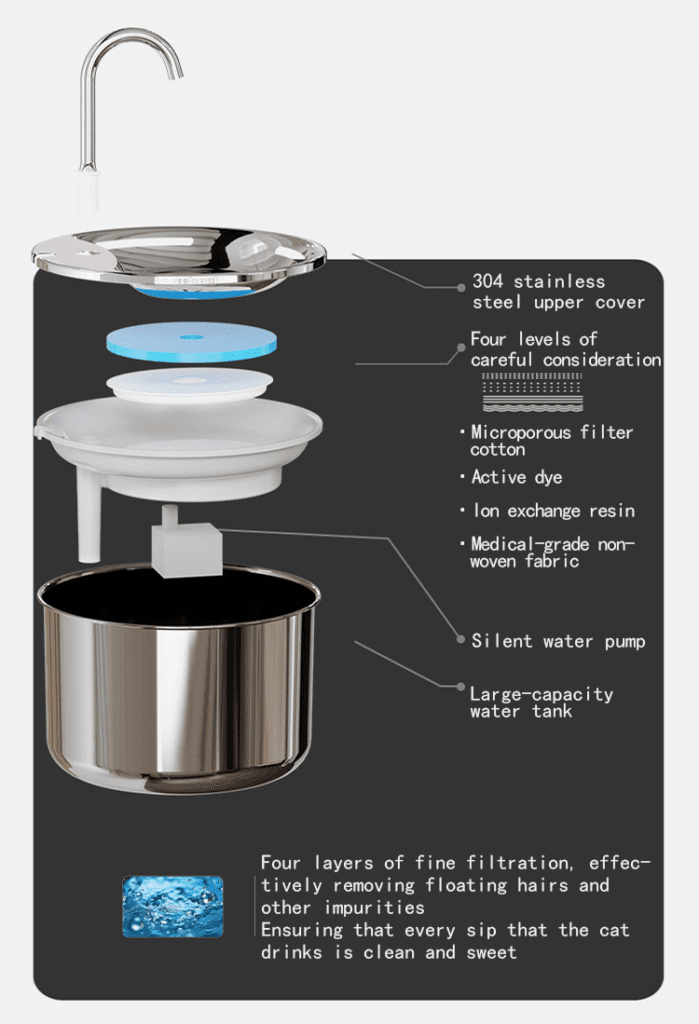
III. Product Three Points: Four-level Filtration, Water Quality Is the Foundation
Medical-grade filtration structure
| Filtration levels | Function |
| Medical non-woven fabric | Capturing hair and impurities |
| Activated carbon | Absorbing odors and residual chlorine |
| Ion exchange resin | Softening water quality |
| Microporous filter element | Fine filtration of micro-particles |
Experimental data comparison (after 7 days)
- Visible impurities in water ↓ 72%
- Residual odor ↓ 65%
- Average daily water intake for pets ↑ 40%+
IV. Product Lecture 4: Intelligent Sensing, Adapting to Pet Nature
Infrared sensing + Instant Start/Stop
| Scene | System Response |
| Pet approaches | System automatically starts |
| Drinking water | Continuous water supply |
| Leave | Delay stop |
Why is this important?
- Reduce ineffective operations
- Lower noise and fear
- Strengthen the positive behavioral feedback of “closer = water”
Plug-and-play | No need for charging | No risk of battery degradation
More suitable for long-term stable use.
Success Case | Real User Feedback
Case: Shanghai · Three Cats Family
“Previously, the three cats drank less than 300ml of water every day. After using this intelligent pet water dispenser, the amount of water they drank stabilized at over 550ml after two weeks, and their urinary problems significantly decreased.”
Case: Shenzhen · Working-class Family with a Pet Dog
“Even if you’re not at home during the day, you can rest assured. It can sense when there is water and won’t waste water. The cleaning process is also very convenient.”
Professional advice & Appointment consultation
Frequently Asked Questions Answered: