Table des matières
Choosing an automatic pet feeder sounds easy until you start comparing products.
One model offers a large food hopper. Another adds WiFi control. Some combine feeding and drinking in one station, while others focus only on automatic food dispensing. Then there are questions about portion control, water capacity, cleaning, cameras and replacement parts.
So what actually matters when choosing a 2-in-1 Automatic Pet Feeder & Water Fountain?
The answer is not simply the number of features.
A useful system should make two everyday tasks easier: feeding your pet consistently and keeping drinking water available with less manual work.
This guide explains the nine factors worth considering before choosing a 2-in-1 feeder and water dispenser, including food and water capacity, feeding control, automatic water supply, smart functions, maintenance and practical usability.
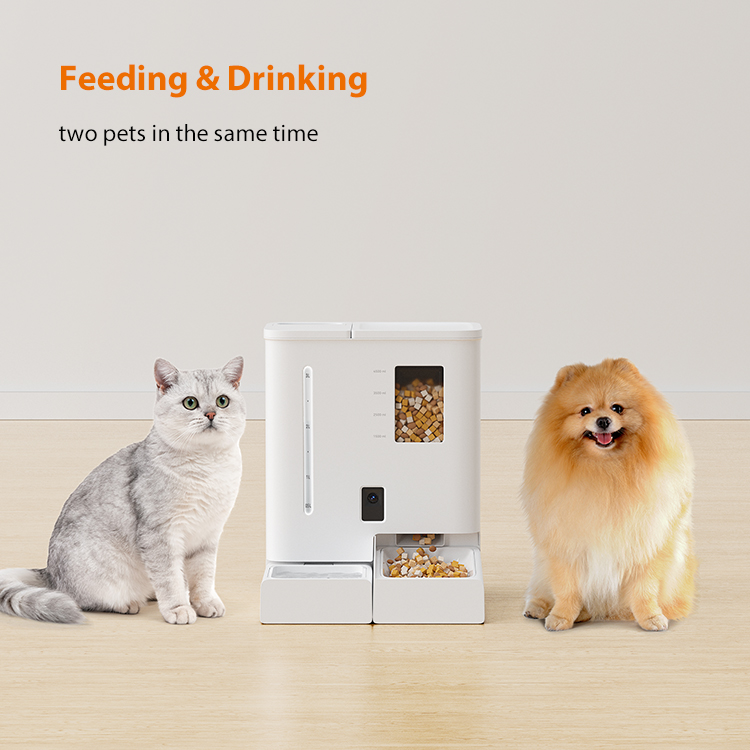
1. Start With the Two Jobs: Feeding and Hydration
The biggest difference between a traditional automatic feeder and a 2-in-1 pet feeder is that a 2-in-1 system is designed around two daily routines instead of one.
Alimentation
An automatic feeder typically stores dry food and dispenses it according to a preset schedule.
Useful features include:
- Repas prévus
- Maîtrise des portions
- Large food storage
- Reliable dispensing
- Easy food loading
Hydratation
The water side should provide a convenient supply of drinking water without requiring the owner to refill a small bowl repeatedly throughout the day.
Useful features include:
- Large water capacity
- Automatic water replenishment
- Easy cleaning
- Accessible drinking area
This distinction is important.
If a product only adds a small water container to an automatic feeder but does not make water management easier, it may not provide much practical value.
The goal of a true pet feeding and watering station is to simplify both routines.
2. Food Capacity: How Much Is Enough?
Food capacity is one of the easiest specifications to understand, but it is often overlooked when comparing automatic feeders.
A small hopper may look compact, but it can require frequent refilling. A larger hopper can reduce maintenance and make the product more convenient for busy households.
For example, a 5L food hopper provides considerably more storage than a compact feeder designed for only a few days of food.
But capacity should not be considered by itself.
Demandez :
- How many pets will use the feeder?
- How much food does each pet eat?
- How frequently does the feeder dispense food?
- Is the food hopper easy to refill?
- Can the hopper be cleaned easily?
For a single indoor cat, a large hopper may mainly provide convenience.
For multiple pets or households where owners spend long hours away from home, larger capacity can become much more valuable.
A practical rule
Larger capacity is useful when it reduces unnecessary refilling without making the feeder difficult to clean or operate.
That is why a 5L automatic pet feeder can be an attractive configuration for everyday use.
3. Water Capacity Matters Just as Much
Many buyers spend considerable time comparing food hopper sizes but pay less attention to the water system.
That is a mistake.
If the water tank is too small, the owner may still need to refill it frequently, reducing one of the main advantages of an automatic system.
A 4L water tank provides a larger reserve of water and can reduce the frequency of manual refilling.
But there is another question:
How does the system replenish the drinking area?
A useful 2-in-1 system should make the relationship between the main tank and drinking area simple.
The basic process should be:
Water Tank → Water Supply → Pet Drinks → Water Replenishes
This is different from simply placing a water bowl next to an automatic feeder.
The objective is to make hydration management less demanding for the owner.
4. Scheduled Feeding Is More Important Than “Automatic”
“Automatic” is a broad term.
A feeder can technically be automatic while offering very little control.
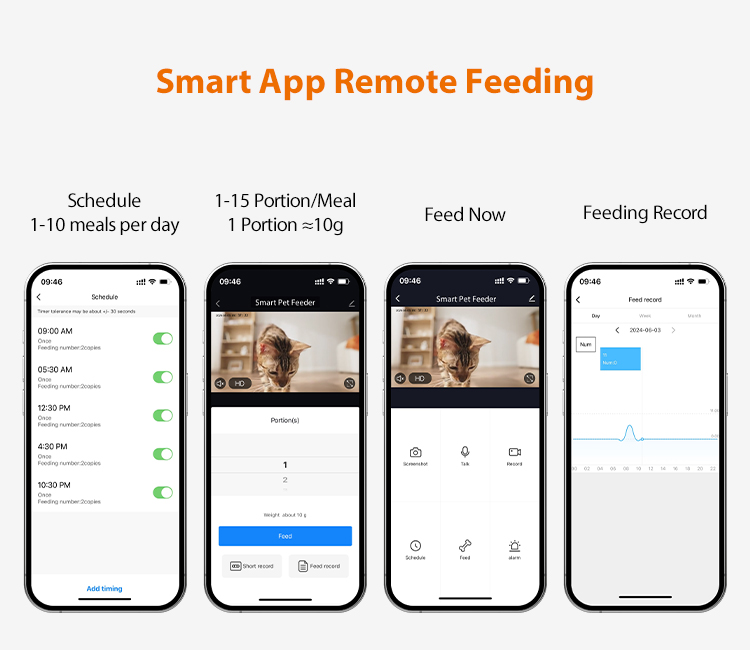
When comparing an automatic cat feeder or automatic dog feeder, look for programmable feeding schedules.
For example, a system may allow owners to establish several meals throughout the day instead of putting all of the food into a bowl at once.
This can make feeding routines easier to organize.
Look for three things:
Time
When should food be dispensed?
Frequency
How many meals should be provided?
Portion
How much should be dispensed at each meal?
These three functions are more useful than simply asking whether a feeder is “automatic.”
5. Portion Control Makes the Feeder More Useful
Timing alone does not solve every feeding problem.
If an automatic feeder releases too much food at once, the owner has less control over the daily feeding routine.
Portion control allows meals to be divided into planned servings.
This can be especially useful when:
- A pet needs smaller meals
- Owners prefer multiple meals throughout the day
- Different feeding schedules are required
- Owners want more predictable food dispensing
The important point is that an automatic feeder should help owners manage feeding, rather than simply automate the act of opening a food container.
6. Smart Features Should Solve a Real Problem
WiFi, apps and cameras are increasingly common in smart pet products.
But more technology does not automatically mean a better feeder.
La bonne question serait plutôt :
What does the smart feature actually allow you to do?
Contrôle des applications
An app can be useful when it allows owners to manage feeding remotely.
Par exemple :
Work runs late → feeding schedule needs to change → owner adjusts the plan remotely.
That is a practical use of smart technology.
HD Camera
A camera can add another layer of usefulness.
Instead of simply dispensing food, the device can allow owners to check what is happening around the feeding area while they are away.
This is particularly useful for owners who spend long periods away from home.
A camera should therefore be viewed as a monitoring feature, not simply a specification.
7. 2-in-1 vs. Two Separate Devices: Which Is Better?
There is no universal answer.
A separate automatic feeder and water fountain can make sense for households that want maximum flexibility.
However, a 2-in-1 system has several practical advantages.
| Consideration | 2-in-1 System | Separate Devices |
|---|---|---|
| Alimentation | Integrated | Separate |
| Eau | Integrated | Separate |
| Space | More compact | More floor space |
| Daily management | Centralized | Multiple devices |
| Setup | One station | Two systems |
| Appearance | Unified | Separate |
| Smart functions | Can be integrated | May be separate |
Choose a 2-in-1 system if you value:
- Space efficiency
- One centralized feeding area
- Moins d'appareils distincts
- Combined food and water management
- A cleaner-looking setup
Consider separate devices if:
- You need highly specialized feeding equipment
- You want different locations for food and water
- You already own a high-quality automatic feeder or fountain
The important point is not that one configuration is always better.
It is about choosing the setup that matches the owner’s actual routine.
8. Cleaning Should Be Part of the Buying Decision
This is one of the most overlooked factors when buying an automatic pet feeder.
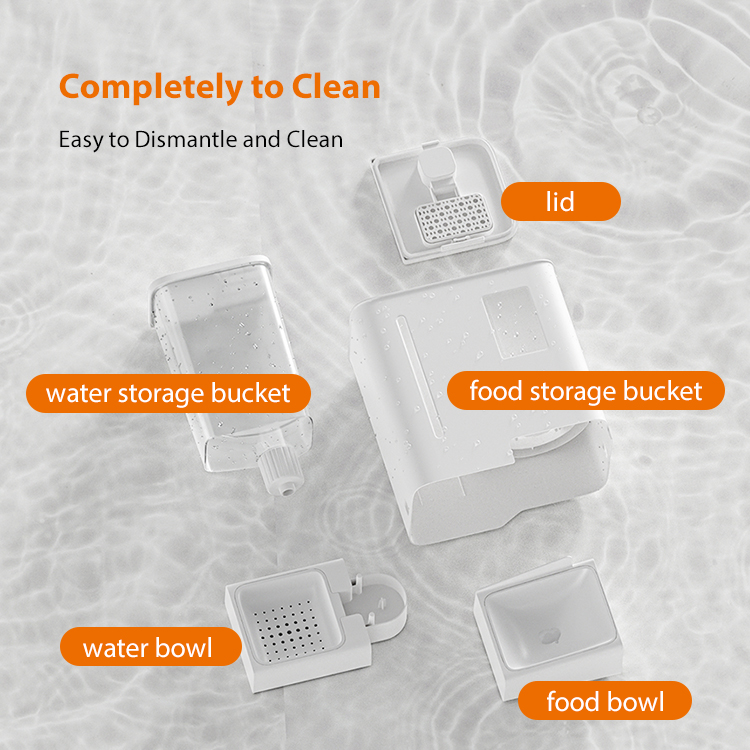
A product can have excellent smart features and large capacity, but if the food and water components are difficult to clean, everyday use can become frustrating.
Before choosing a pet feeder and water fountain combo, check:
Food Components
- Is the food hopper accessible?
- Can the food bowl be removed?
- Are food-contact areas easy to wipe?
Water Components
- Can the water tank be accessed easily?
- Can the drinking area be cleaned?
- Are water-contact components removable?
- Are filters replaceable if the product uses filtration?
Electronic Components
Electronic components should be kept separate from areas that require regular washing whenever the product design allows it.
This is especially important for an integrated feeding and watering station because it contains both food and water components.
9. Think About What Happens After You Buy
For consumers, this means asking:
Can I easily clean and maintain it?
For retailers and distributors, there are additional questions.
Replacement Parts
Can customers obtain commonly replaced components?
Examples may include:
- Filters
- Water pumps
- Feeding components
- Bowls
- Other consumable parts
Product Support
B2B buyers should also consider:
- Warranty
- Technical support
- User documentation
- Emballage
- Replacement components
- Personnalisation
For pet brands and private-label businesses, the supplier’s customization capability may be just as important as the product itself.
Potential options can include:
- Logo customization
- Product color
- Emballage
- User manual
- Configuration du produit
A good product line is not simply about the initial order. It also needs to be manageable after the product reaches the market.
What Does a Well-Designed 2-in-1 Pet Feeder Look Like?
After considering all nine factors, the ideal configuration becomes clearer.
A practical 2-in-1 automatic pet feeder and water fountain should bring several functions together without making everyday use unnecessarily complicated.
For example, the DogCatSupplies 2-in-1 system combines:
5L Food Hopper
Provides substantial dry-food storage and reduces frequent refilling.
4L Water Tank
Provides a larger water reserve for everyday hydration management.
Scheduled Feeding
Allows owners to organize meals around a consistent feeding routine.
Portion Control
Provides greater control over food dispensing.
Automatic Water Replenishment
Helps maintain the water supply as pets drink.
Contrôle des applications
Allows feeding management when owners are away.
HD Camera
Provides remote visibility around the feeding area.
Integrated 2-in-1 Design
Combines food and water management into one station.
The value is not any single specification.
It is the combination:
Food Storage + Feeding Control + Water Supply + Smart Management + Monitoring
in one system.
Is a 2-in-1 Automatic Pet Feeder Worth It?
For the right household, the answer can be yes.
If you already have a reliable feeder and water fountain that work well independently, there may be no reason to replace them.
But if you are setting up a pet-care station from scratch, a 2-in-1 automatic pet feeder and water dispenser can reduce the number of devices you need while combining several everyday functions.
It can be particularly useful for:
- Busy pet owners
- Indoor cats
- Small dogs
- Multi-pet households
- People who travel
- Owners who want remote feeding control
For B2B buyers, the multifunctional design can also make the product attractive as a retail or private-label offering because it addresses several common pet-care needs in one product.
2-in-1 Automatic Pet Feeder: Quick Buying Checklist
Before purchasing or sourcing a product, use this checklist:
| Question | Why It Matters |
|---|---|
| Does it combine food and water? | Confirms the actual 2-in-1 function |
| How large is the food hopper? | Determines refill frequency |
| How large is the water tank? | Determines water refill frequency |
| Can feeding times be scheduled? | Supports consistent routines |
| Can portions be controlled? | Improves feeding management |
| Is water replenished automatically? | Reduces manual work |
| Can feeding be controlled remotely? | Useful when away |
| Does it include a camera? | Enables remote monitoring |
| Is it easy to clean? | Important for long-term use |
| Existe-t-il des pièces de rechange ? | Supports continued use |
| Can the product be customized? | Important for B2B buyers |
Save this checklist if you are comparing several automatic pet feeders and water fountains.
Foire aux questions
What is a 2-in-1 automatic pet feeder and water fountain?
It is an integrated pet-care system that combines automatic food dispensing with a water supply system in one station.
Is a 2-in-1 pet feeder suitable for cats and dogs?
Yes. These systems can be used for cats and dogs, although feeding portions, bowl size and food requirements should be matched to the individual pet.
Is a 5L food hopper large enough for a pet?
Capacity requirements depend on the pet, food type and feeding schedule. A 5L hopper provides substantial storage and can reduce how often the owner needs to refill it.
How much water does a 2-in-1 pet feeder need?
The required capacity depends on the number and size of pets. A 4L water tank provides a substantial supply for everyday use.
Is an automatic pet feeder better than manual feeding?
Automatic feeding can make scheduled and portion-controlled feeding easier to manage, particularly for owners with busy schedules. It does not replace normal pet care and monitoring.
Is a 2-in-1 feeder better than a separate water fountain?
It depends on the user’s needs. A 2-in-1 system prioritizes convenience, centralized management and space efficiency, while separate devices may offer greater flexibility.
What should I look for in a smart pet feeder?
Look beyond WiFi or app connectivity. Consider feeding schedules, portion control, food capacity, water capacity, automatic water supply, cleaning and remote monitoring.
Final Takeaway
The best 2-in-1 automatic pet feeder and water fountain is not necessarily the one with the longest feature list.
It is the one that makes everyday pet care genuinely easier.
Before choosing a product, look at the complete system:
Can it store enough food?
Can it provide enough water?
Can meals be scheduled and portioned?
Does the water supply require frequent manual refilling?
Can you manage feeding when you’re away?
Can you check on your pet remotely?
Is the system easy to clean and maintain?
For owners looking for a centralized solution, a combination of 5L food storage, 4L water capacity, scheduled feeding, portion control, automatic water replenishment, app control and HD monitoring can turn a simple feeder into a more complete daily pet-care station.
And for pet brands, retailers and distributors, the same combination creates a multifunctional product with a clear consumer proposition:
One station. Food, water and smarter everyday pet care.