Table of Contents
Introduction
The domestic cat, despite thousands of years of cohabitation with humans, remains a predator at its core. Yet the modern indoor environment offers little opportunity for the behaviors that define a cat’s natural existence—stalking, chasing, pouncing, and capturing. For the estimated 61% of U.S. cats classified as overweight or obese, according to the Association for Pet Obesity Prevention, the sedentary indoor lifestyle carries measurable health consequences. Beyond weight gain, insufficient daily activity manifests in scratched furniture, nighttime restlessness, excessive vocalization, and destructive chewing.
These are not behavioral anomalies. They are predictable outcomes of a predatory animal confined to a space that provides limited stimuli. Indoor spaces can be monotonous for cats, who are active by nature. When the hunting drive has no appropriate outlet, cats redirect that energy toward whatever is available—curtains, couch arms, or their owner’s ankles during the late hours.
The response from the pet industry has been significant. The global pet interactive toys market was valued at USD 245.33 million in 2025 and is projected to grow at a CAGR of 8.55%, reaching USD 435.75 million by 2032. This growth reflects a broader shift: consumers increasingly view toys not merely as playthings but as tools for wellness and behavioral health. For pet brands, retailers, and wholesale buyers, this translates into a sustained demand for products that deliver genuine behavioral engagement rather than fleeting novelty.
This article examines one such product category—intelligent interactive rolling pet toys—from two perspectives: what they offer to indoor cats and their owners, and what they represent for businesses seeking reliable, differentiated inventory in a growing market.
The Case for Interactive Play Devices
Benefits for Cats and Their Owners
Play is not optional for indoor cats. It is a behavioral necessity. Cats that lack sufficient opportunities for physical and mental activity are more prone to stress-related behaviors, including overgrooming that can lead to bald patches or skin irritation. They may become withdrawn or, conversely, display play aggression toward household members—biting, swatting, and ambushing as substitutes for appropriate prey.
Interactive toys address this need by providing structured activity that mimics the unpredictability of real prey. Devices that move erratically, change direction, or vary in speed trigger the hunting sequence that cats are hardwired to follow: search, stalk, chase, pounce, and capture. When a cat successfully engages with such a toy, the behavioral loop completes, reducing the drive to seek alternative outlets.
For owners, the benefits extend beyond preserved furniture. A cat that receives adequate daily activity is generally calmer during quiet hours, less likely to interrupt sleep cycles, and more content during periods of owner absence. Automatic toys also offer hands-free operation, allowing cats to initiate play independently. This is particularly valuable for households where work schedules limit interactive play sessions.
Commercial Value for Pet Brands and Retailers
From a business standpoint, the interactive pet toy category represents a high-margin opportunity with favorable demand dynamics. The market is transitioning from a niche accessory segment to a mainstream, benefit-driven consumer goods category. Consumers are increasingly educated about feline behavioral needs and are willing to invest in products that deliver measurable outcomes.
For wholesale buyers and pet brands, this means several advantages. First, the category commands premium pricing compared to basic toys, supporting healthier margins. Second, the differentiation potential is substantial—products with unique movement patterns, dual functionality, or superior build quality stand out in a crowded retail environment. Third, the repeat purchase cycle is favorable; cats habituate to toys over time, creating ongoing replacement demand.
Retailers who stock intelligent interactive toys also benefit from the educational aspect of the category. These products lend themselves to in-store demonstrations, social media content, and owner education—all of which drive engagement and brand loyalty.
Evaluating Automatic Cat Toys: Common Shortcomings
Not all automatic cat toys deliver on their promises. A review of the current market reveals several recurring issues that frustrate both cats and their owners.
Predictable movement patterns. Many motorized toys follow fixed paths—circles, back-and-forth lines, or other repetitive motions. Cats, being intelligent predators, quickly habituate to predictable stimuli. Once a cat has “figured out” a toy’s pattern, interest wanes rapidly. The toy becomes background noise rather than an engaging activity.
Single-function design. The majority of automatic toys offer one mode of play. If that mode does not match a particular cat’s prey preference—and individual cats do have distinct preferences, often learned from their mothers—the toy fails to generate sustained interest. A one-size-fits-all approach rarely works in feline play.
Durability concerns. Cheap materials, weak motors, and poor assembly lead to early failure. Toys that break after a few sessions frustrate owners and create negative brand associations. For wholesale buyers, high return rates and negative reviews erode profitability.
Limited engagement duration. Short battery life or automatic shut-off that cuts sessions too early prevents cats from reaching the “capture” phase of the hunting sequence. Incomplete play cycles can increase frustration rather than reduce it.
No solo-play capability. Some toys require owner activation or supervision, defeating the purpose for households where cats spend significant time alone.
These shortcomings point to a clear product gap: a durable, multi-mode, unpredictably moving toy that cats can operate independently.
Intelligent Interactive Rolling Pet Toy—Hardware and Practical Benefits
The Intelligent Interactive Rolling Pet Toy addresses the limitations outlined above through a combination of thoughtful engineering and behavioral understanding.
Dual-Play Mode Design
The toy offers two distinct play modes. The 7-hole play mat shuttle mode directs the rolling ball through a patterned mat with seven openings, creating a confined but unpredictable path that encourages batting, tracking, and pouncing. The free ground rolling mode releases the ball onto any flat surface, where it moves according to its internal programming without path constraints.
This dual approach serves different play styles. Some cats prefer the structured challenge of the mat—the ball appears and disappears through holes, mimicking prey emerging from cover. Others respond better to open-floor movement, where the ball can travel greater distances and change direction more dramatically. Offering both modes within a single product increases the likelihood that a given cat will find one that matches its hunting preference.
Speed and Runtime Configurations
The toy features two speed settings—fast and slow—allowing owners to match intensity to their cat’s energy level, age, or mood. Kittens and high-energy adults may prefer the faster setting for vigorous chase sessions; senior cats or those with lower activity tolerance benefit from the slower pace.
Two operational modes address different usage scenarios. The intelligent standby mode keeps the toy in a low-power state, activating only when the cat interacts with it. This conserves battery and ensures the toy is ready when the cat initiates play. The timed automatic shutdown mode runs for a preset duration then powers off, preventing overstimulation and managing battery consumption.
Materials and Build Quality
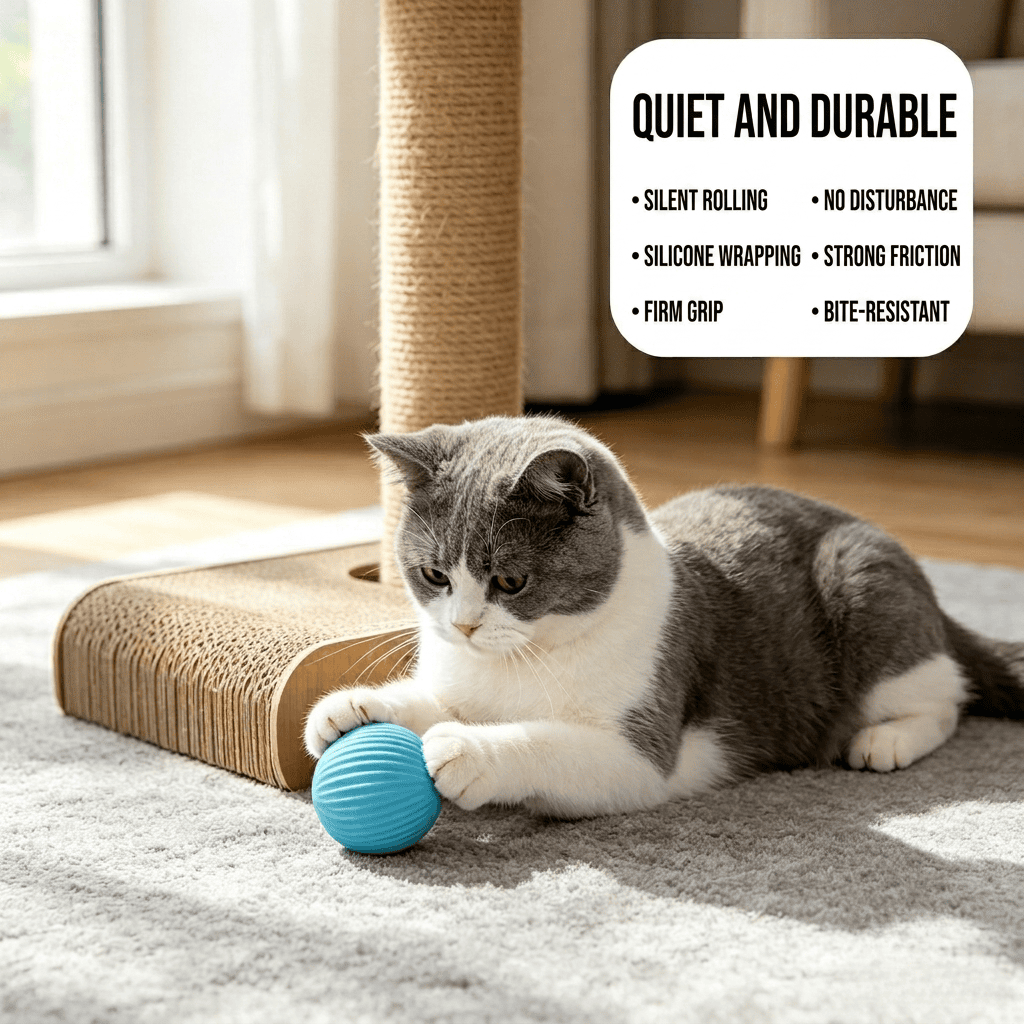
The rolling ball is constructed from toy-grade PC and TPR composite materials. PC provides structural durability against biting and impact; TPR offers a soft, non-slip surface that is gentle on floors and comfortable for cats to bat. The combination is wear-resistant and bite-resistant and free from harmful odors—important considerations for products that cats will mouth and chew.
The accompanying play mat uses waterproof and scratch-resistant fabric. Spills, dirt, and claw marks wipe clean with a damp cloth, addressing a common pain point for owners of fabric-based pet products. The mat stays in place during active play, reducing the frustration of a shifting play surface.
Battery and Runtime
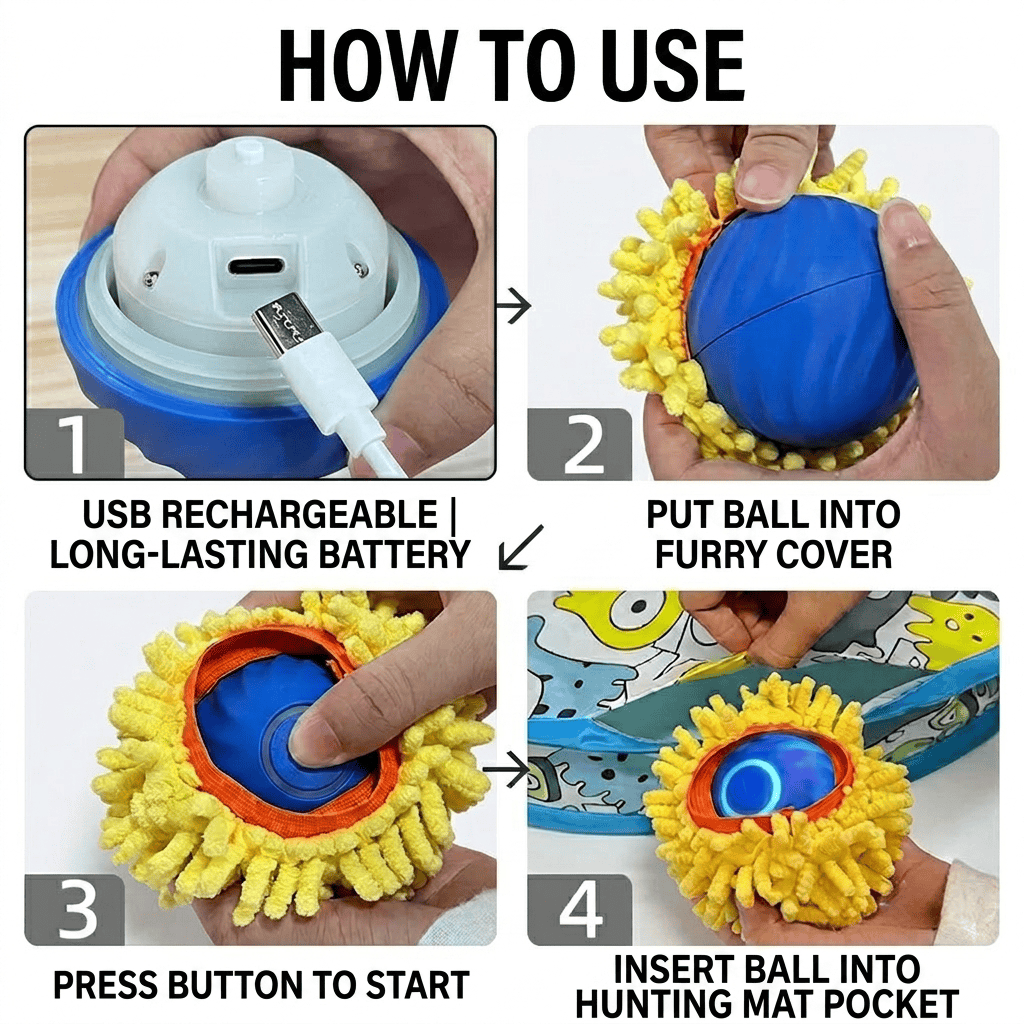
The built-in 300mAh lithium battery provides approximately three hours of continuous operation on a full charge. For most households, this translates to multiple play sessions between charges. The rechargeable design eliminates the ongoing cost and waste of disposable batteries.
The Critical Feature—Randomized Movement
The toy’s most important behavioral feature is its randomized, irregular rolling trajectory. Rather than following a fixed pattern, the ball changes direction unpredictably, mimicking the erratic escape behavior of small prey. This unpredictability is what sustains a cat’s interest over time. When a toy’s movement cannot be anticipated, the cat remains engaged, treating each session as a new hunting opportunity rather than a repetitive exercise.
For cats that spend time home alone, this feature provides independent activity that alleviates boredom and separation-related anxiety. The toy operates without owner supervision, allowing the cat to initiate play whenever the urge arises. This is particularly valuable for single-cat households where no playmate is available.
Why Some Indoor Cats Ignore Ordinary Toys—A Behavioral Perspective
A cat that shows no interest in playthings is not necessarily uninterested in play. More often, the toy itself fails to trigger the appropriate behavioral response.
Habituation is a primary factor. Research has demonstrated that cats presented with the same toy multiple times become progressively less interested, then show renewed response to a new toy identical except for color. This indicates that loss of interest is driven by habituation to the toy’s overall stimulus properties rather than fatigue with the activity itself. The cat remains motivated to play; the specific toy has simply become predictable.
Prey preference varies individually. Cats develop preferences for particular types of prey movement, often influenced by early learning from their mothers. A cat that ignores a slowly rolling ball may spring into action at the sight of a feather fluttering overhead. The toy must match the cat’s internal template of “what is worth chasing.”
Movement must mimic real prey. Cats ignore toys that move randomly, too fast, or directly toward them. Effective play movement includes pauses, direction changes, and the appearance of escape—the ball should seem to be trying to get away, not simply moving for movement’s sake. This is why the Intelligent Interactive Rolling Pet Toy’s randomized trajectory is not a luxury feature but a behavioral necessity.
Novelty must be managed. Even the best toy will eventually lose its appeal if it remains constantly available. This is not a failure of the toy but a feature of feline cognition. The solution lies not in discarding toys but in managing their availability—a topic addressed in the following section.
One-Stop OEM/ODM Customization from an Integrated Factory
For pet brands, retailers, and wholesale buyers, the ability to customize products is often as important as the product itself. The Intelligent Interactive Rolling Pet Toy is manufactured by a self-producing, self-selling source factory that offers comprehensive OEM and ODM services.
Customization Options
Appearance and branding. The factory supports shell color modification, allowing buyers to match the toy’s exterior to their brand palette. Logo silk-screening is available on both the rolling ball and the play mat, providing visible branding on all visible components.
Packaging. Full retail packaging customization is offered, from box design and material selection to insert configuration. This enables brands to present the product in packaging that aligns with their market positioning—whether premium, eco-friendly, or value-oriented.
Functional adjustments. Product feature parameter modification is available for buyers with specific market requirements. Speed settings, runtime configurations, and other functional parameters can be adjusted within engineering constraints.
Quality Assurance and Production
The factory implements multi-layer quality inspection throughout the production process, from incoming material verification to in-process checks and final functional testing. This systematic approach to quality control reduces the post-sale failure rate that plagues many single-function rolling toys on the market.
Large-batch orders are fulfilled with stable delivery schedules. Production planning, material procurement, and assembly are coordinated to meet agreed timelines, reducing the supply chain uncertainty that can disrupt retail inventory planning.
Regulatory Compliance and Export Readiness
Products are manufactured to meet complete European and American export certification requirements, including applicable safety standards for children’s and pet products. This eliminates a common barrier for international buyers, who would otherwise need to conduct their own compliance testing or risk customs delays.
Flexible Minimum Order Quantities
The factory offers flexible MOQ (Minimum Order Quantity) arrangements, accommodating both small-batch trial orders for emerging brands and large-volume production for established retailers. This flexibility allows buyers to test market response before committing to substantial inventory.
Competitive Differentiation
The exclusive dual-play mode design distinguishes this product from conventional single-function rolling toys. For retailers and brands, this differentiation translates into a clearer value proposition for end customers—and, consequently, stronger margins. A product that genuinely delivers on its behavioral promises generates fewer returns, better reviews, and higher customer lifetime value.
Frequently Asked Questions
Q: How long does the battery last on a full charge? The built-in 300mAh lithium battery provides approximately three hours of continuous operation. Actual runtime varies by speed setting and usage pattern.
Q: Is the toy safe for cats that chew aggressively? The rolling ball is constructed from toy-grade PC and TPR composite materials that are wear-resistant and bite-resistant. The materials are non-toxic and free from harmful odors. However, as with any pet product, initial supervision is recommended.
Q: Can the toy be customized with my brand’s logo? Yes. The factory supports logo silk-screening on both the rolling ball and the play mat. Packaging customization is also available.
Q: What is the minimum order quantity for wholesale purchases? MOQ is flexible. The factory accommodates both small trial orders and large production runs. Contact the sales team for specific quantity requirements.
Q: Does the product meet European and American safety standards? Yes. The product is manufactured to meet applicable European and American export certifications, including relevant safety standards for pet products.
Q: My cat ignores most toys. Will this one be different? The randomized movement pattern and dual-play mode design address two common reasons cats lose interest in toys: predictability and mismatch with prey preference. However, individual variation exists, and toy rotation is recommended to maintain engagement over time.
Q: How do I clean the play mat? The mat is made from waterproof, scratch-resistant fabric. Wipe with a damp cloth to remove dirt and stains. Avoid harsh chemicals or machine washing unless specified.
Q: What is the warranty on bulk orders? Warranty terms are negotiated as part of the wholesale agreement. Contact the factory directly for specific warranty information.
Conclusion
The indoor cat’s hunting instinct does not disappear when the door closes. It remains, seeking appropriate expression. For owners, providing that expression through intelligent, unpredictable play devices addresses behavioral issues, supports physical health, and strengthens the human-animal bond. For businesses, the growing demand for such products represents a sustained market opportunity—one that rewards quality, differentiation, and genuine behavioral effectiveness.
The Intelligent Interactive Rolling Pet Toy offers a solution that works for both audiences: a thoughtfully engineered product that cats actually engage with, backed by a factory that understands what brands and retailers need to succeed. Whether you are a cat owner seeking to enrich your pet’s daily life or a business looking for a reliable, customizable product line, this is a category worth serious attention.
For wholesale inquiries, sample requests, or OEM/ODM customization discussions, contact the factory directly. Explore how the Intelligent Interactive Rolling Pet Toy can become part of your brand’s offering.