Treat-dispensing dog toys combine interactive play, food rewards, and chewing in a single product category. For pet brands, importers, distributors, and online retailers, they also offer an opportunity to expand an existing dog toy assortment with products designed around everyday behavioral needs.
However, choosing a product for wholesale is not simply a matter of finding an attractive shape at a competitive price. Buyers need to consider product function, material specifications, treat-opening design, durability, cleaning requirements, packaging, and the supplier’s ability to support repeat orders.
This guide explains how to evaluate treat-dispensing dog toys for your product range, what to check before placing a bulk order, and how OEM/ODM customization can help your brand differentiate its offering.
Why Add Treat-Dispensing Dog Toys to Your Product Range?
Dog owners increasingly look for toys that offer more than a single function. A product that combines chewing, movement, and food rewards can be easier to position around several practical use cases.
One Product, Multiple Play Functions
A conventional ball mainly supports chasing and retrieving. A basic chew toy focuses on chewing. A treat dispenser adds a food-based interaction that encourages dogs to manipulate the toy to obtain a reward.
Depending on its design, a treat-dispensing toy may support:
- Interactive play and food-based enrichment.
- Chewing activities using an appropriate toy.
- Rolling, chasing, and retrieving.
- Indoor play sessions and everyday engagement.
For retailers, these combined functions can make product demonstrations more compelling and provide several clear selling points for product pages, short-form videos, and in-store displays.
Clear Consumer Problems to Address
A successful product listing should explain the need behind the purchase, rather than simply listing features.
For example, a treat-dispensing toy can be positioned for dog owners who want to introduce more variety into snack time, provide an alternative chewing activity, or encourage movement during play.
Avoid promising that one toy will eliminate anxiety, prevent every destructive behavior, or deliver specific health benefits. Clear, realistic product positioning helps establish customer trust and reduces the risk of misleading claims.
Opportunities Across Multiple Sales Channels
Treat-dispensing dog toys can be considered for several channels:
- Pet specialty stores: Products with clear demonstrations and easy-to-explain functions.
- Online pet retailers: Toys with distinctive designs, practical feature descriptions, and strong product photography.
- Amazon and other marketplaces: Products that can be differentiated through useful imagery, accurate specifications, and clear use instructions.
- Wholesale distribution: Products that fit an existing dog toy assortment and support consistent replenishment.
- Private-label brands: Existing designs that can be aligned with a brand’s visual identity and product positioning.
The right product depends on your target customer, retail price range, channel requirements, and intended product assortment.
What Types of Treat-Dispensing Dog Toys Should Buyers Compare?
Before requesting quotations, define which type of interaction you want the product to deliver.
Rolling Treat Balls
These toys release treats when dogs push or roll them. They can be suitable for brands targeting movement-based play and simple food-reward activities.
When evaluating them, check whether the opening works with the intended food sizes and whether treats are released too quickly during normal use.
Puzzle-Style Dispensers
Puzzle toys require dogs to manipulate compartments or moving parts to access food. They can support more complex interactions, although the difficulty must remain appropriate for the intended customer group.
Buyers should review the number of components, cleaning access, assembly complexity, and whether the instructions explain how to introduce the toy.
Chew-Friendly Treat Dispensers
These designs combine a chewable body with openings for treats. They can be positioned around interactive chewing and food rewards.
Important evaluation points include the material specification, wall thickness, rounded edges, opening design, and suitability for the intended chewing strength.
Multi-Function Bouncing Dispensers
Some toys combine treat dispensing with bouncing and chasing. This creates additional movement during play and gives the product more than one demonstrable feature.
For a buyer, the key question is whether the combination creates a useful consumer benefit without compromising ease of cleaning, material performance, or safe use.
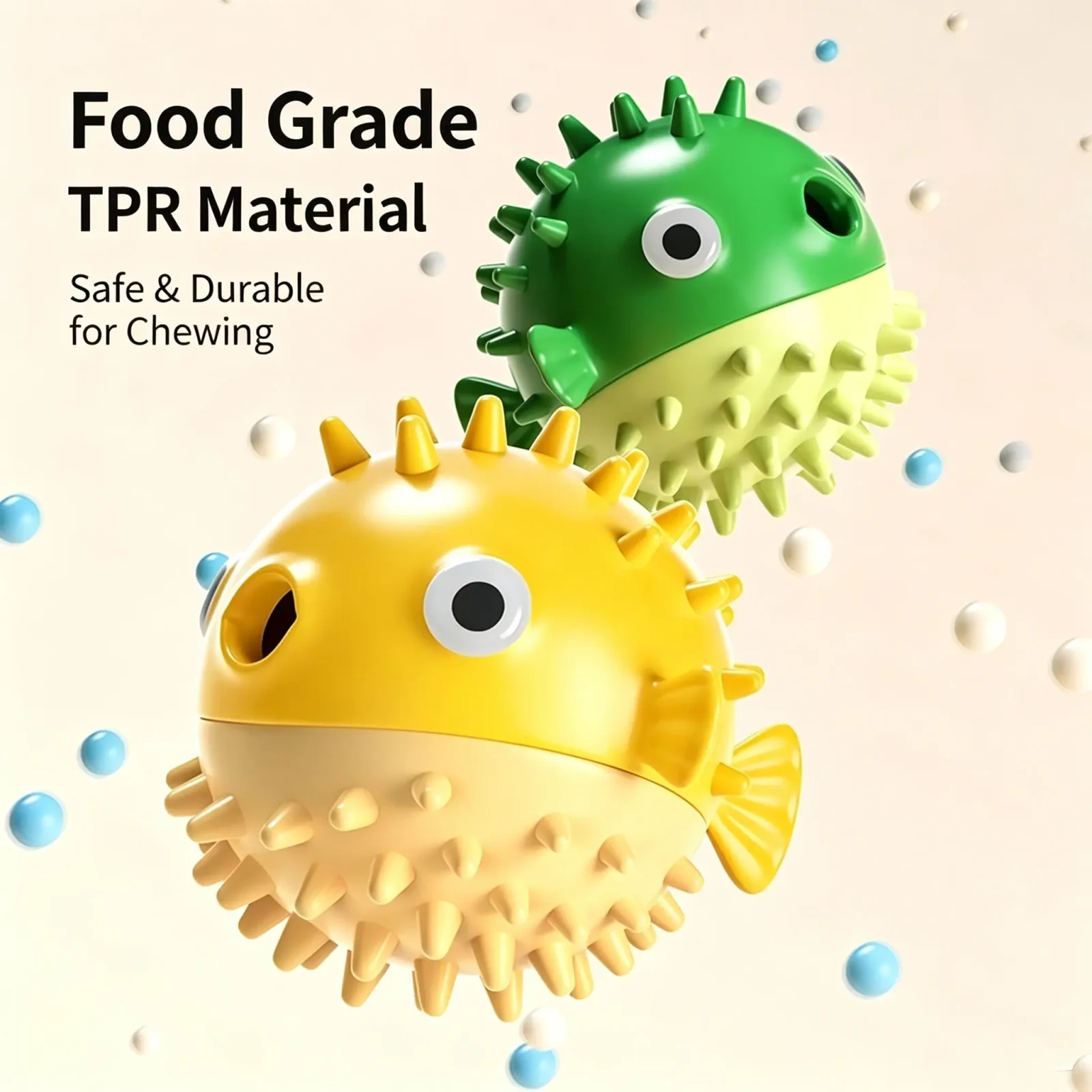
A Product Example: Pufferfish-Shaped Interactive Treat-Dispensing Dog Toy
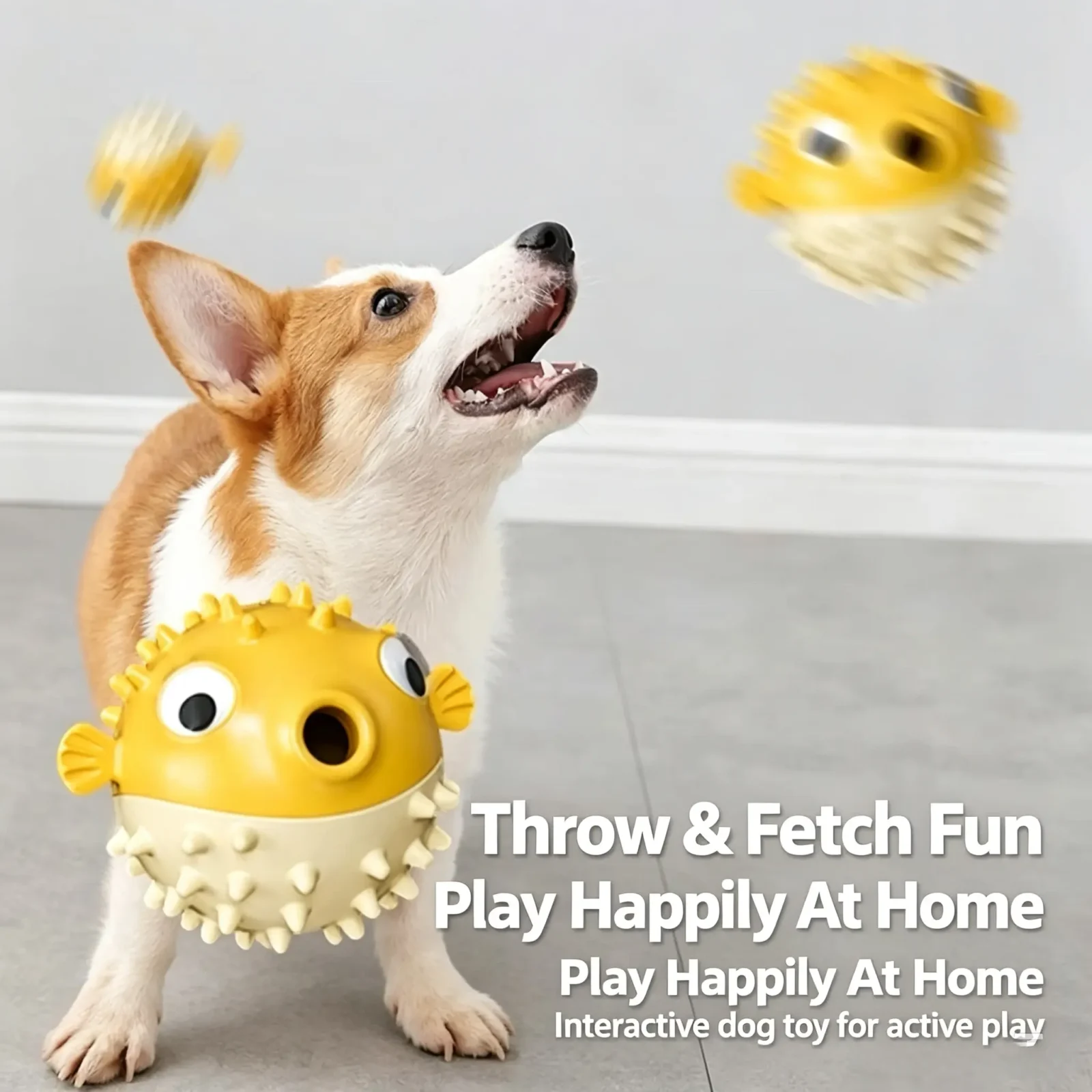
The treat dispensing dog toy is one example of a multi-function design that combines food rewards, chewing, and bouncing.
Its main listed features include:
- Distinctive pufferfish shape: A recognizable silhouette can help a product stand out in assortment photography and short-form video demonstrations.
- Thickened TPR body: The product page specifies food-grade TPR. Buyers should request the applicable material documentation and confirm that the final specification matches their target market’s requirements.
- Built-in treat openings: Dogs can roll and chew the toy to release kibble or snacks. Buyers should test the opening against the actual treat sizes their customers are likely to use.
- Rebound of up to 65%: The listed rebound specification supports a movement-focused product story. Buyers should confirm how the figure was measured and whether test conditions are documented before using it in packaging or advertising.
- Rounded raised nubs: The textured exterior is designed to support a chew-friendly interaction and gentle gum massage. Any dental-related marketing should be reviewed carefully and should not imply that the toy replaces established dental care.
- Easy rinsing: The product page describes rinsing with clean water after play. Buyers should verify cleaning instructions for the production version and check whether residue can collect around the openings and textured areas.
- OEM/ODM customization: The listed options include private-label branding, color customization, structural adjustments, functional modifications, and packaging design, subject to project confirmation.
This product offers a useful starting point for buyers evaluating a toy that combines several functions within a single design. Its suitability for a particular channel should still be established through samples, documentation, and commercial review.
Seven Checks Before Ordering Treat-Dispensing Dog Toys in Bulk
A well-structured purchasing process helps reduce avoidable problems before a product enters your inventory.
1. Confirm the Target Customer and Intended Use
Start by defining the customer segment you want to serve.
Are you targeting owners of small companion dogs, medium-sized dogs, or larger dogs? Is the product intended primarily for rolling play, chewing, or food-based enrichment?
These decisions affect the required size, material properties, opening dimensions, packaging information, and product positioning.
Do not rely on breed names alone when assessing suitability. Individual chewing behavior varies significantly.
2. Review Material Specifications
Ask the supplier to identify the exact material used in the offered SKU and provide relevant supporting documentation.
For a TPR toy, confirm the material grade, color specification, and whether any coatings, inserts, or additional components are present.
The phrase “food-grade” should be supported by documentation appropriate to the product and intended use. It should not automatically be interpreted as proof that every part of the finished toy meets every applicable safety requirement.
If your target market requires specific testing or chemical restrictions, communicate those requirements before production rather than after the goods are manufactured.
3. Test the Treat-Dispensing Function
A product may look attractive in a photograph but perform poorly when a dog uses it.
Test the actual sample with several suitable treat sizes and observe:
- Whether treats fit through the intended opening.
- Whether they are released too quickly or become difficult to extract.
- Whether the toy moves as described.
- Whether residue can be removed after use.
- Whether repeated movement affects the opening or overall structure.
Record your acceptance criteria before the production order. A clear test plan makes it easier to compare suppliers and evaluate later batches.
4. Assess Durability and Component Retention
Do not judge durability solely by appearance or a supplier’s general description.
Ask what testing has been performed, how the test was conducted, and whether the results apply to the exact model being purchased.
For a product with a thickened body and textured exterior, inspect the surface, edges, openings, and any connection points. Examine the sample after repeated use under an agreed test procedure.
The supplier’s listed claim of 10,000+ chewing cycles should be accompanied by a clear definition of the test method and conditions before you use it as a verified comparative claim.
No toy should be marketed as indestructible without compelling evidence, and no product should be assumed suitable for every chewing style.
5. Check Cleaning and Maintenance
Cleaning is a practical purchasing consideration because leftover food can collect inside dispensing openings and around textured surfaces.
Evaluate whether the product can be cleaned using the method specified by the supplier. Check how easily the interior and openings can be accessed and dried.
Ask for clear care instructions that can be adapted for packaging, product listings, and customer support.
A product that is easy to explain and maintain can reduce avoidable customer confusion.
6. Review Packaging and Retail Readiness
Packaging should communicate the product’s function and intended use clearly.
Before confirming an order, review:
- Product name and key features.
- Correct dimensions and material information.
- Recommended use and cleaning instructions.
- Relevant warnings and supervision guidance.
- Barcode, branding, and retail packaging requirements.
- Carton dimensions and packing quantities for shipping calculations.
If you sell through a marketplace, confirm the platform’s current requirements before finalizing the packaging design.
7. Validate the Supplier’s Repeat-Order Process
The first sample is only one part of a purchasing decision. You also need confidence that the approved specifications can be maintained in production.
Discuss how the supplier manages sample approval, material changes, color consistency, production inspections, packaging checks, and corrective actions for defects.
For ongoing orders, retain an approved reference sample and a written specification. This gives both parties a clearer basis for evaluating production consistency.
OEM vs. ODM: Which Customization Route Is Right for Your Brand?
The best approach depends on how much differentiation you need and how quickly you want to launch.
OEM: Customize an Existing Design
OEM is often a practical starting point when an existing product already fits your intended market.
Depending on the supplier’s capabilities, customization may include:
- Logo or private-label branding.
- Color selection.
- Packaging and printed materials.
- Agreed changes to dimensions or structure.
- Selected functional adjustments.
Before proceeding, confirm which options are available for the specific SKU and whether changes require new tooling, additional testing, or a revised production schedule.
ODM: Develop a More Distinctive Product
ODM may be more appropriate when your brand needs a different shape, a modified interaction, or a product concept developed with the supplier.
The process may involve concept review, drawings, prototypes, material selection, tooling assessment, sample testing, and production approval.
Not every proposed feature will be commercially or technically feasible. Establishing the required performance, target cost, estimated quantity, and approval process early can make development more efficient.
How to Choose Between Them
Choose an existing-design customization route when speed, a simpler development process, and a clearly defined specification are priorities.
Consider a more extensive development project when differentiation is central to your brand strategy and you have the budget and timeline to validate a new design.
In either case, define ownership of tooling, design rights, approved specifications, and any exclusivity terms in the commercial agreement.
How to Request a More Accurate Wholesale Quotation
A vague request such as “Please quote your dog toys” often produces an incomplete comparison.
Instead, prepare a short product brief containing the following information: Product: Treat-dispensing dog toy, including the preferred model or reference. Target market: Countries or regions where the product will be sold. Estimated quantity: Initial order quantity and expected reorder volume, if known. Customization: Logo, colors, packaging, and any required structural or functional changes. Compliance: Applicable product safety, testing, labeling, and documentation requirements. Delivery: Destination country, preferred shipping arrangement, and required delivery window. Quality requirements: Sample approval, inspection criteria, and any documented performance tests.
Ask suppliers to identify which costs are included in their quotations and which are charged separately. If you need door-to-door delivery with customs clearance and duties included, request the applicable service scope and written quotation terms.
For a fair comparison, evaluate total landed cost, specification compliance, quality controls, lead time, and communication—not just the unit price.
Frequently Asked Questions
Can I order treat-dispensing dog toys with my own brand? The product page lists private-label branding and other OEM/ODM customization options. Confirm the available logo method, artwork requirements, packaging choices, minimum order quantity, and any additional costs for your selected configuration.
Can the toy’s color or structure be customized? The listed service includes color customization and structural or functional modifications. The exact scope depends on the project and should be confirmed before quotation and sample approval.
What minimum order quantity is available? The supplier’s website describes its cooperation model as supporting low-MOQ and small-batch orders. Request the current MOQ for the specific model and customization package rather than assuming the same quantity applies to every project.
How should buyers verify durability claims? Request the test method, test conditions, acceptance criteria, and documentation for the exact product specification. Conduct your own sample evaluation against the intended use and target-market requirements.
Can the supplier arrange delivery to my destination? The product page describes door-to-door logistics and customs-clearance support. Ask for a destination-specific quotation that identifies the included services, applicable duties and taxes, exclusions, and delivery assumptions.
Build a More Competitive Treat-Dispensing Dog Toy Assortment
The right treat-dispensing dog toy should offer a clear consumer benefit and meet the practical requirements of your sales channel. A distinctive design can help attract attention, but material verification, product testing, packaging, and repeat-order consistency are equally important.
For pet brands, wholesalers, importers, and e-commerce sellers looking for a multi-function product, the treat dispensing dog toy combines a pufferfish-shaped design with treat dispensing, chew-friendly texture, and bouncing play.
Interested in wholesale pricing or private-label customization? Contact the DogCatSupplies team with your target quantity, market, branding requirements, and delivery destination. Request product specifications, sample options, and an OEM/ODM quotation to evaluate whether this model fits your assortment.